
|
The National Programme on Conservation and Utilization of Microbial Genetic Resources and Invertebrates of Agricultural Importance |
česká verze english version contact |

VURV-F VURV-A VURV-M VURV-T RIBM CCF CCPO CCBAS SPCH UPOC-FUN CCM CCDM CCDBC
|
    
|

|
    
|
|
  
|
|
   
|
 Collection of Brewery Microorganisms (RIBM), (VÚPS, a. s., Praha)
|
 Lyophilisates  Living fungal collection on slopes  Ascosphaera apis – fruit-body, bee parasite  Aspergillus clavatus – conidiophores, feed contaminant  Monascus purpureus – colonies, producer of monakolin  Penicillium verrucosum – colonies, producer of ochratoxin A |

|
 Phytophthora alni (V8A, 20°C, 7 days) Phytophthora alni (V8A, 20°C, 7 days) Phytophthora citrophthora (V8A, 20°C, 7 days) Phytophthora citrophthora (V8A, 20°C, 7 days) Phytophthora gonapodyides (PDA, 20°C, 7 days) Phytophthora gonapodyides (PDA, 20°C, 7 days) Phytophthora plurivora (V8A, 20°C, 7 days) Phytophthora plurivora (V8A, 20°C, 7 days) |

|
 fermentor  strains on sloping agars  Sacharomyces cerevisiae  Y lipolytica Candida sp. lipase detection |
|
       
|
 Culture Collection of Basidiomycetes (CCBAS), (MBÚ AV ČR, v. v. i., Praha)
|
    
|
 Collection of Hop Pathogens, (ChI, s. r. o., Žatec)
|
    
|
 Collection of Phytopathogenic Microorganisms UPOC
|
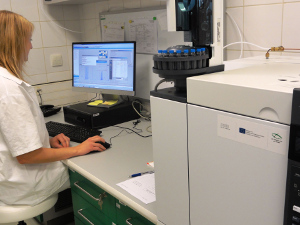 Fatty Acid Analysis Fatty Acid Analysis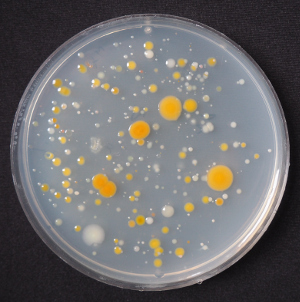 Diversity of pigmenting bacterial strains Diversity of pigmenting bacterial strains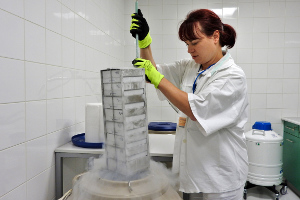 Preservation of strains in liquid nitrogen Preservation of strains in liquid nitrogen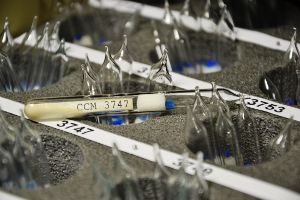 Lyophilized collection strain Lyophilized collection strain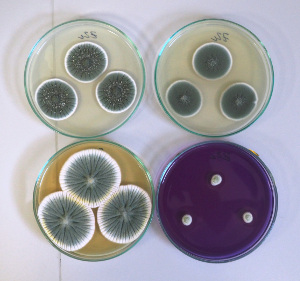 The macroscopic morphology of filamentous fungi The macroscopic morphology of filamentous fungi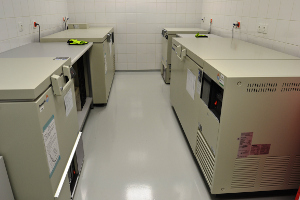 Storage of cultures in deep-freeze boxes Storage of cultures in deep-freeze boxes |

|
 Biohazard flow box Biohazard flow box Yeast deposition on agar media  Penicillium strains Penicillium strains Cryopreservation in the freezer Cryopreservation in the freezer Cultures in broths and in lyophilized form Cultures in broths and in lyophilized form Microscope Olympus BX-43 Microscope Olympus BX-43.png) Morfology of filamentous fungi (P. roqueforti, YES, 25 °C, 7 days) Morfology of filamentous fungi (P. roqueforti, YES, 25 °C, 7 days) Thermal cycler Biometra Thermal cycler Biometra |


|
 Biohazard flow box  Cryopreservation in the freezer  Yeast deposition on agar media  Microscope Olympus BX-43  Morphology of filamentous fungi (P. crustosum, CYA, 25 °C, 7 days)  Morphology of filamentous fungi (P. paneum, CYA, 25 °C, 7 days)  Thermal cycler Biometra |